A Review of "Big Magic: Creative Living Beyond Fear" by Elizabeth Gilbert
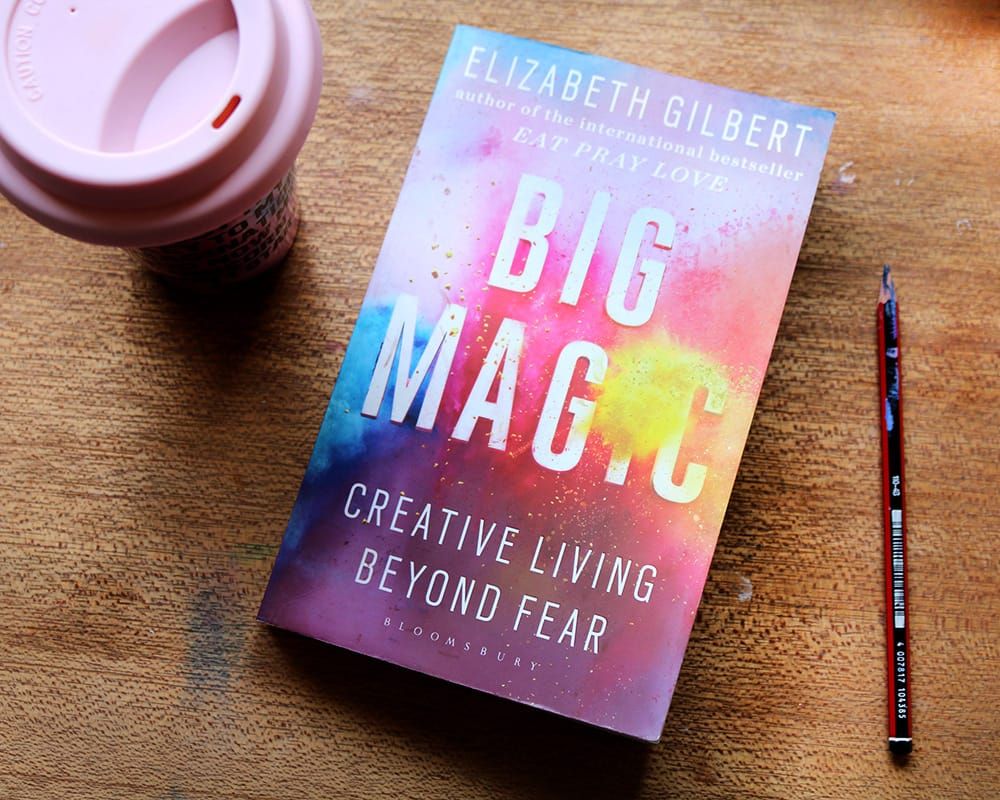
When I was at Johns Hopkins, I had to choose a book to read and write a report on. The various books on the list were about writing tools, the life of a writer, and the creativity in the writing process. Helpful things for sure, if you're not an experienced writer taking the course. Or if you feel like you need more tools in your toolbelt. Heck, I had initially chosen to read "How to be Heard" by Roxane Gay, which was supposed to be a practical guidance for writers who want to use their voice to write powerful work to share with the world, from a no-holds-barred prominent novelist and columnist.
The only reason I didn't? The book hadn't come out yet.
Thinking on it now, I should be able to get and read it. It would probably be very helpful for this blog.
When that option turned out to be a dud, I chose a book talking about procrastination and self-doubt. Two prevalent problems in my life, fueled by anxiety, a tad bit of depression, and the shitstorm that was happening in America at that point. It was 2025.
I chose a goody. I think the best way to describe her lessons is to reiterate what she said in her conclusion:
"Creativity is sacred, and it is not sacred. What we make matters enormously, and it doesn't matter at all. We toil alone, and we are accompanied by spirits. We are terrified, and we are brave. Art is a crushing chore and a wonderful privilege. Only when we are at our most playful can divinity finally get serious with us. Make space for all these paradoxes to be equally true inside your soul, and I promise - you can make anything. So please calm down now and get back to work, okay?"
Gilbert is pleasantly honest to the point of bluntness, and she talks about her thought process and how she came across these paradoxes to successfully write. The way she wrote makes reading the book feel as if you're reading a holy text in the most spiritual way, but not bordering so much on religion that it pushes you away. Looking back on it, I shouldn't be surprised; she did write "Eat, Pray, Love".
She introduces the way of writing as a process of pleasurable creation, and as a way that should only be if you enjoy the act of writing. She advocates for the healthy writer - not the toiling, suffering artist - but the writer that has fun with their characters, their story, and their lives. When she speaks to the reader, she addresses the heart of her lessons and stories.
Such as: Yes, there is a way to kill your darlings, but it doesn't have to include killing yourself.
Best of all, she tells you to not write for others, "Whenever anybody tells me they want to write a book in order to help other people, I always think, Oh, please don't. Please don't try to help me....I would so much rather that you wrote a book in order to entertain yourself than to help me. Or if your subject matter is darker and more serious, I would prefer that you made your art in order to save yourself, or to relieve yourself of some great psychic burden, rather than to save or relieve us."
She's why I started my blog writing about my mental health, and why I want to continue writing on my blog. Why there's not comment sections under my blog post, but will be when I post on Medium. I write for myself first, to get my thoughts on the digital page. And I would only accept constructive critique or commentary from the comment section - as a writer, I know how to roll with the punches.
Her words are what I have on the home page of my website, because it simply encompasses what I hope to do. "I simply vowed to the universe that I would write forever, regardless of the result..." Her honesty is an admiration, her bluntness a push of courage. She says to write if you love writing and if writing loves you.
That's an important part: do you love what you do? Or do you want to do something else? Anything else?
I love the feeling of the keyboard underneath my fingers. How fast my fingers can fly across, creating a sentence in mere seconds. Creating a paragraph in a minute. Heck, I do typing tests because it combines my love of typing with the spirit of competition. Yes, I'm a nerd. A fiercely competitive nerd. If there's any correlation between finger speed and muscle gains or calories burned, then I'm a typing sportsplayer.
Best of all, this book resonated with me on a spiritual way that gave light to what I wanted my future goals to be. While reading it for class, I was also going through my literary vision statement. That statement was about answering the big questions: How do you define the kind of writing you wish to do the most? How would you describe your literary vision of yourself?
It was supposed to be a short essay, about 300 words. And I could have written the generic mumbo jumbo, the things that professors want to see. "I want to be a (journalist, columnist, advocate), and have my writing be (inspiring, bold, transformative)." I could have done it the easy way.
But reading the book gave me the realization that I needed to change my statement. In the time I wrote - I've written for the Snakebite Asclepius Foundation, Tailored Tutor, Amazon Sports and the Whitman Wire - the most enjoyable part was researching and writing what held my interest. I wanted to explain these fascinating concepts - antivenom, AI-assisted tutoring, neuroscience and public opinion - to myself, and in doing so help others that thought like me. It's fun to stack these dominoes, and even more fun to watch as they fall and reveal the big picture.
So, am I doing the Big Magic, as Gilbert had talked about? This magic is the magic of creation, of enjoying the process of production and display that makes one feel satisfied and happy. This big magic could be anything as far as the artist is concerned - cooking, ceramics, painting, crocheting, writing, researching - whatever produces the flow state and allows you to keep moving forward in life, despite the obstacles in your way.
There's even a little bonus fun in doing this, because as Gilbert says in the book, sometimes dressing up to attract a story is a way to go. I have my trusty dragon-sculpted magic wand and jewelry that attract my fantasy-loving heart, as well as knicknacks and trinkets that remind me of the neuroscience and biology that oh so fascinates me. I dress up for the occasion, and that story comes to me - what science shall I delve into, what fantastical prompt shall flow through my fingers?
Another lesson from the book is making a contract with an idea: negotiating with it, deciding what that idea wants from me as much as I want from it, and how I'm willing to bring it to form. And if I don't want to go through with the contract, that's fine; that idea will find someone else willing to work with it.
It's advice like this that make me feel less guilty about carrying an idea in my head, tossing and turning it, cooking it, and then writing it out later, once all the kinks have been figured out in my head and my fingers feel like touching the keyboard.
If there was ever a tattoo I would get on my arm or wrist that wasn't dragon-inspired, it would be her chapter-separating stars. And as someone that's nervous about the thought of permanent ink on my skin, that's the biggest advocation I can give for her book.