Captain's Log: Lava Lamps Were a Smooth Flow...Today
I prepped a lava lamp to show the kids last night, and realized I got some things wrong.
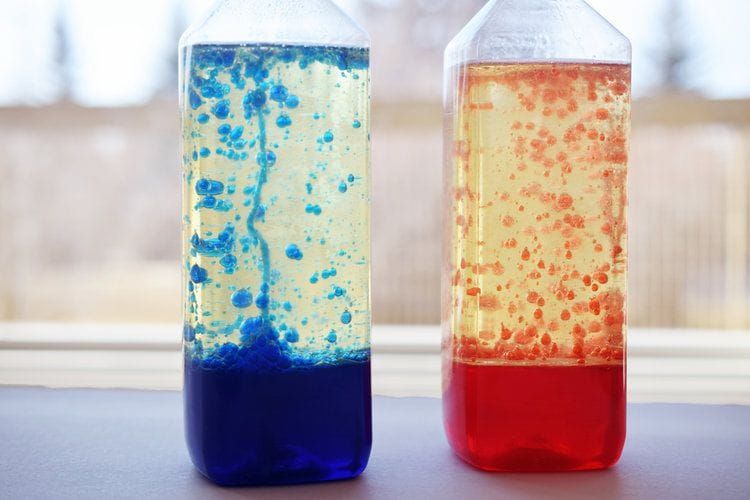
I wrote a pretty long script during the weekend to explain the science of homemade lava lamps, like every other wacky science thing I've been doing before the classes start. It was beautiful and touched my soul. The reading time could have been about 15 minutes, and I was very proud.
But then I prepped a lamp to show the kids last night, and realized I got some things wrong.
Now, I didn't get everything wrong. But I don't like not knowing everything when I try to do thorough research. So, I'll let you know what I know to be true, along with the captain's log for today's wacky science class.
Cause yeah, it went pretty smoothly.
First relief is that there was no baking soda that needed to be involved. No flour either, so the mess could be handled. I also had not one, not two, but four tarps with me. And I only had to use two of them! That meant the mess was kept to a thankful minimum. Yay me!
I also had lots of color dyes, so the kids could choose to put whatever colors they wanted in their lamp. They could choose multiple colors as well, if they wanted to. They also filled their own containers - a tad bit of water at the bottom, as a medium for the chemical reaction - while I poured in the vegetable oil, and I gave each of them a tablet of alka seltzer. I stressed to them as well that they only got one tablet. The whole, "you get what you get and you don't throw a fit" lecture that I heard when I was a kid.
I had a flashlight working for them to see the fizzy reaction with bright light, but I didn't have enough flashlights to go around - I did have the batteries, however, and a pile of flashlights sans the batteries. One kid was an MVP today and helped me fill those flashlights up so that everyone got a chance to see their lamp through bright light. That kid also allowed me to use their lava lamp for the demonstration. Again, a real MVP. Another kid helped a lot too with the flashlights and I think some cleanup.
Naturally, I gave them both one of those small packets of alka-seltzers as a reward. While everyone had one tablet, they had two. Twice the chances for fun. And then I told them to not announce their prize, so that the other kids wouldn't ask for one.
Yeah, they blabbed after a minute. So I had to explain to the kids a bit on the difference between being really helpful and just looking helpful, and how these two kids were really helpful, and that's why they got a reward. Fun stuff.
Luckily, I have enough tablets for tomorrow's class too. And vegetable oil. And bottles! And I still have one for myself, that I'll be showing the kids tomorrow when I prepare for everything. For about thirty seconds, it'll be a little TV show to keep them occupied. I hope.
So, what exactly was happening?
Well, it was pretty - okay, mostly - similar to the volcanoes lesson. Alka-seltzer tablets are made of citric acid and sodium bicarbonate, with possibly some unimportant filler. The volcano eruption was made with acetic acid and sodium bicarbonate, so these two reactions were sisters. One was an acid-base neutralization reaction, and the other...acid-base reaction. I'd have to look it up to see why, but there wasn't any eruption happening inside the lava lamps bottles, even with the caps on.
Of course, if you read my previous posts, the sodium bicarbonate and acid and the water make for carbonic acid - unstable, will break down practically immediately - and thus carbon dioxide is born.
It's made at the bottom of the bottle, where gas and fluid densities and matter interact within a fixed container. Oil is less dense than water, so the water keeps at the bottom of the bottle, oil making its claim on top. Carbon dioxide is less dense than oil and water, so it goes through both liquid mediums to reach the surface where it can try to escape.
How exactly it brings the colored dye with it is not all clear with me, because I like to look unnecessarily deep into these things to figure out what's happening on the molecular level. What I can say from a cursory look is that it seems like matter displacement and something to do with molecules interacting, and when I asked ChatGPT it started saying to imagine the bubble as a rowboat. Still not quite clear, so I'll look into that more tomorrow. For the funsies of it all.
Fun thing about learning all this, though: I didn't know alka-seltzer tablets were used for this. When I had heartburn or acid indigestion - which can happen if I don't take my medication properly - I took tums, the chewy kind with the assorted berries flavor. Before then, I was pouring baking soda into a glass of water and guzzling that down to stop the burn.
And no, I didn't really know why the baking soda stopped the acid burn in my throat. I just went with one of the quick solutions suggested on the internet. When the google AI said that alka-seltzer is used for heartburn and it contained sodium bicarbonate, it clicked for me why.
Sometimes these realizations come slow for me. I will never claim to be the most observable person on the obvious.
Again, the fact that these chemical reactions are happening without a sentience, consciousness, or thought is fascinating to me. My passion may be biology, but chemistry has real bonding potential! Pun intended.
While I don't think I explained everything as properly as I could to the kids, I did give them a rundown and told them how they can make this experiment at home. So hopefully they'll be showing off to their folks. Each kid got a lamp, so each kid went home happy.
Tomorrow, with the older kids, it's not the experiment part that has me worried, but the interacting-with-kids part. I'll make a kit for the older kids so they can have fun for themselves independently at a different table, while I give the lecture to the younger kids. Hopefully, this works out.
If not, I'll just ask the kids what I can do to improve.