Homemade Volcanoes Science Part 2: Deeper and Hotter
I woke up Monday morning and found, to my utter relief and surprise, a message from my boss reminding me this week was spring break. I had more chances to plan for a better lecture! So here's more science.
Last Sunday night, I went to sleep unsatisfied. I was tossing and turning, unwillingly storming up ideas on how I could amp up the quality of my lecture on homemade volcanoes and volcano science to the kids. After all, some of these kids no doubt had ADHD. Some were probably more visual thinkers, while others were probably a bit more hands-on. At this point, I could probably guess who was who. And I wanted to make my lessons more accessible to them. But first lesson was coming up the next day, Monday afternoon. Did I have enough time to make visual aids? How about a poster?
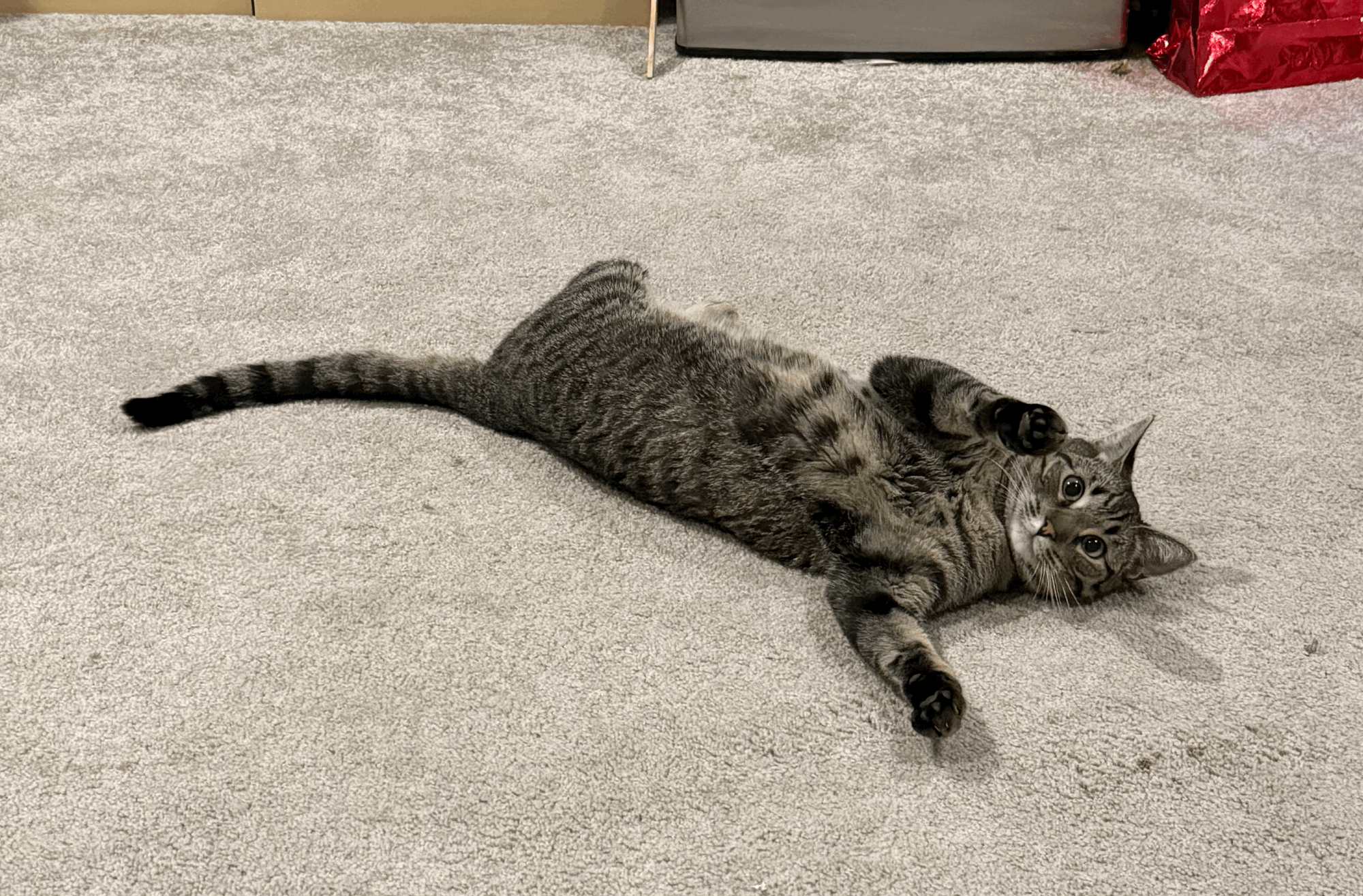
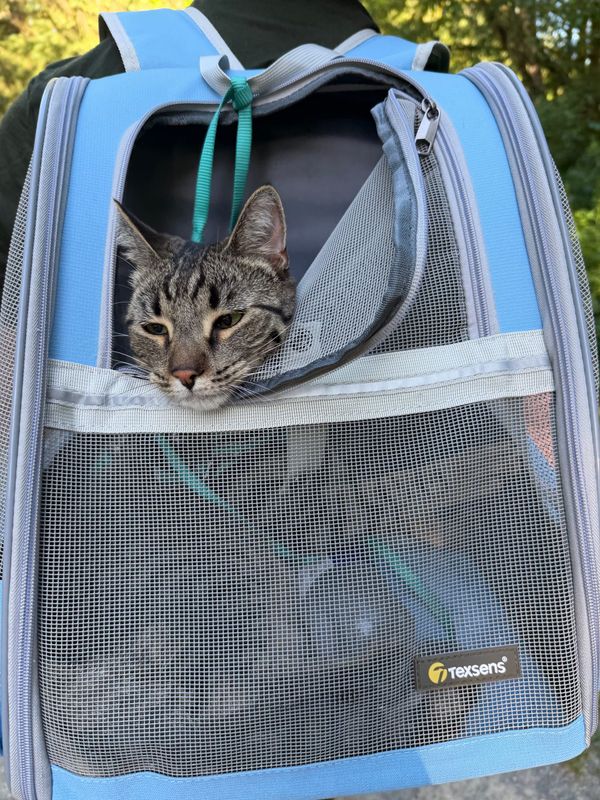
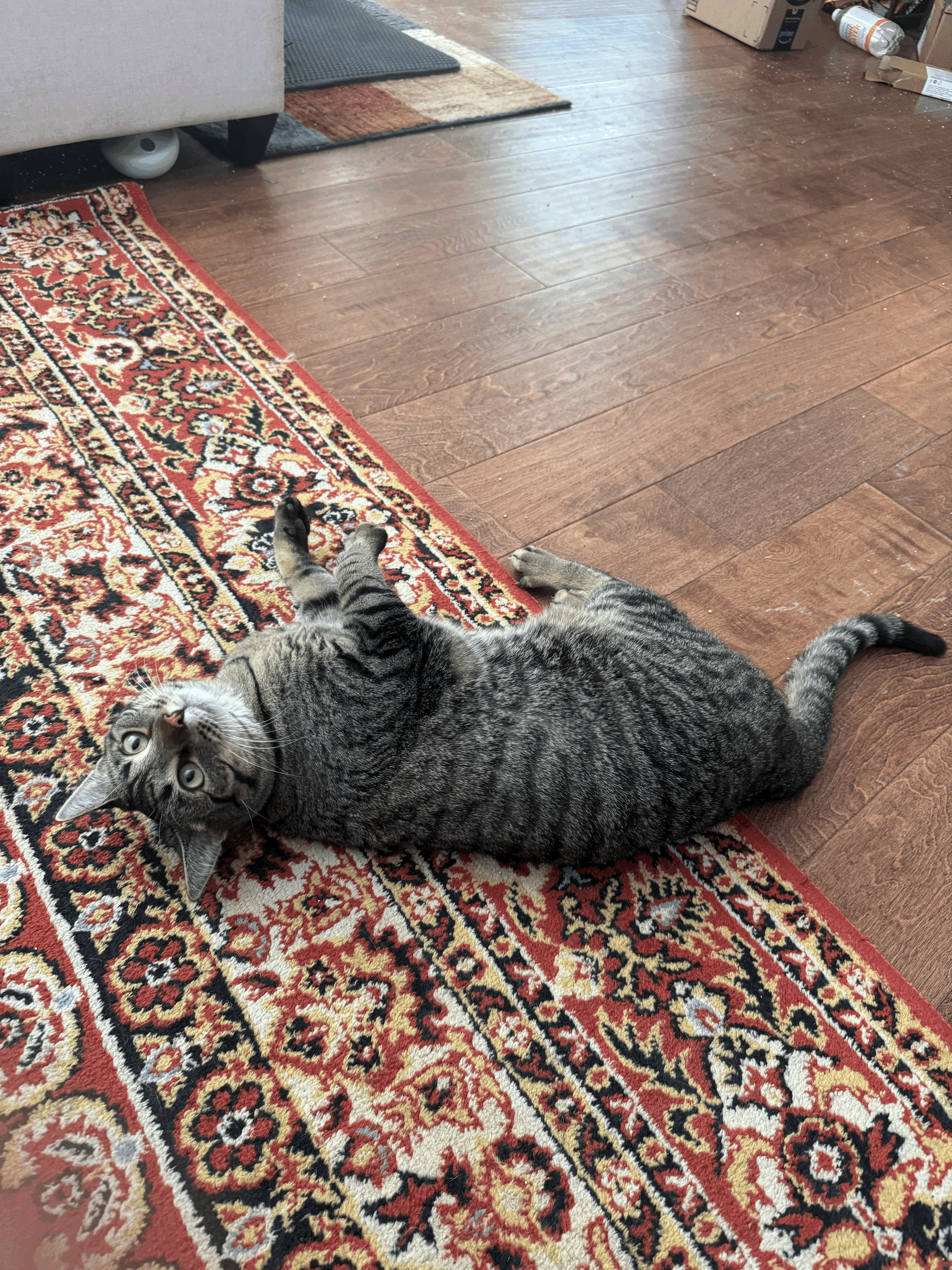
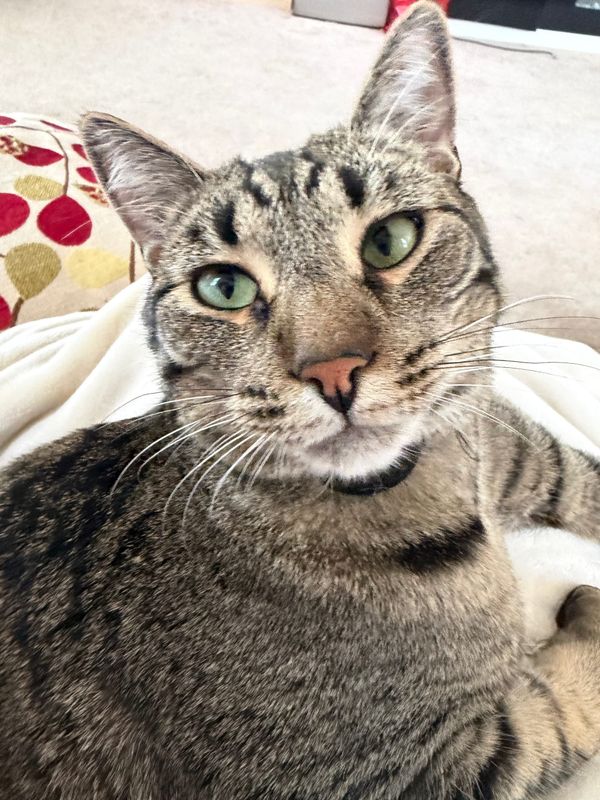
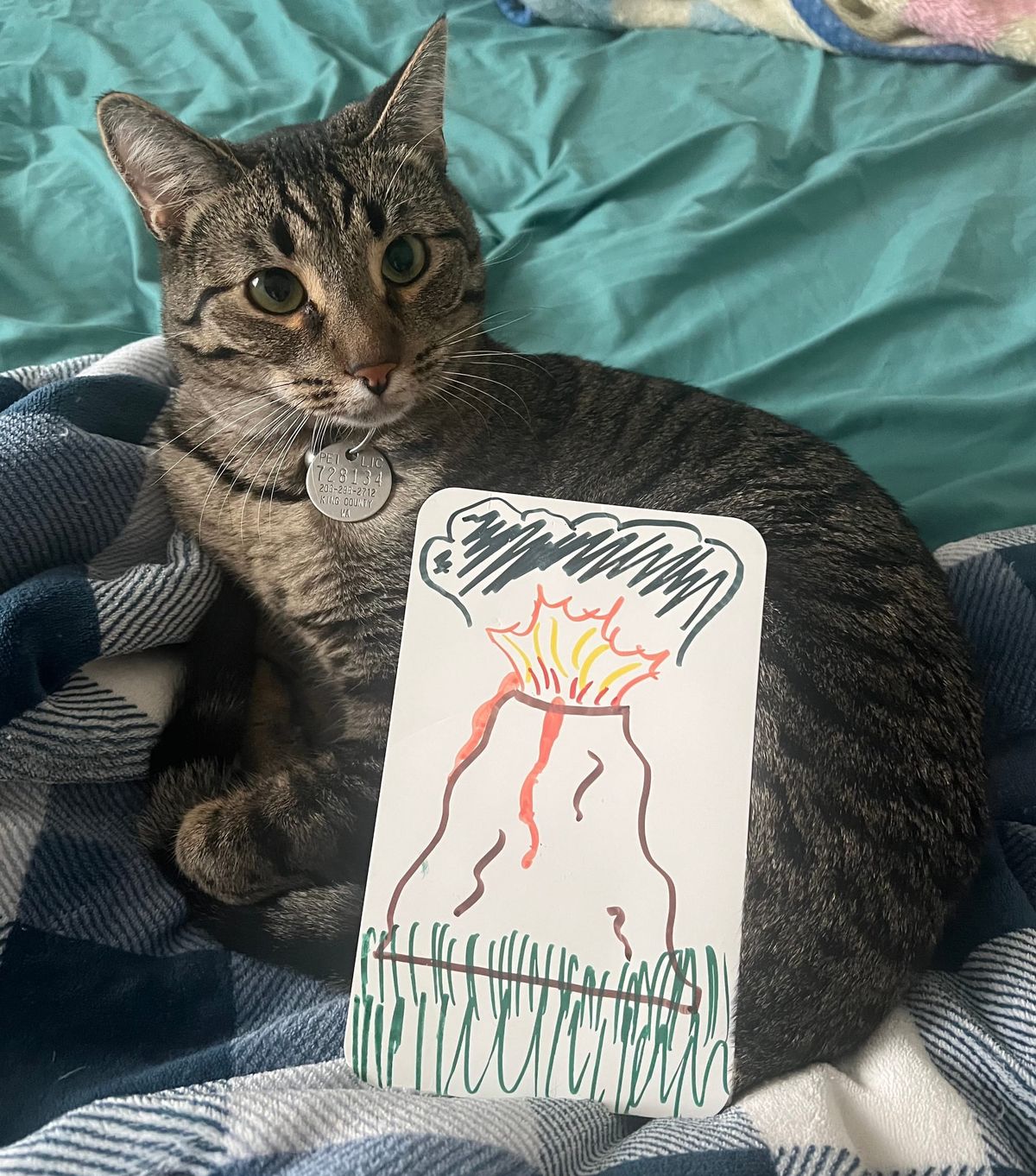
To top it all off, my cat decided that he wasn't satisfied with just sleeping beside me all day. No, he had the energy to play, and I was his target. At midnight.
So the little bastard in my bed and the bastard that is my head gave me a very hard night.
I woke up Monday morning and found, to my utter relief and surprise, a message from my boss reminding me this week was spring break. No classes for the week! No money income either, for that matter, but yay I had more chances to plan for a better lecture!
It might seem like a bit of overdoing it to some to plan a poster, write out a lecture, figure out how to make things entertaining, interactive, and still intellectual, but for me, the experience of giving these science lessons are more personal.
I want to be the science teacher of my dreams, that caters to my ADHD, autism, and introversion. I also want to teach these kids the lessons of science and real life earlier than when I'd learned them. Volcano science can be just about baking soda and vinegar. But it can also be about chemistry, physics, geology, and how theory and education can be put into practice via models of natural events. Things that I learned late in my undergraduate years, when I thought it was easy to go from recalling information for exams to actually using that knowledge. But there is a bridge between academics and reality, and hands-on work really is different from filling in bubbles and short answer responses.
So to simulate reality, part of my lecture will be about looking at real and famous volcanoes: Mount St. Helens, Pompeii's Mt. Vesuvius, and Hawaii's shield volcano Mauna Loa.
When it comes to the poster, I think I'll be putting the volcanoes at the bottom, split into three different sections. The chemistry of these volcanoes, I'll put at the top. Underneath the chemistry of homemade volcanoes, because for all the similarities it's actually quite interesting how that homemade and volcanic chemistry aligns with the physics of bubbles.
The homemade volcano is a simple recipe of baking soda with vinegar, where once the two combine you get carbonic acid, which breaks apart into water, carbon dioxide, and gas. An acid-base neutralization reaction that creates internal pressure in the volcano bottle to fight against the external pressure of the bottle's materials. Real volcanoes get that internal pressure from magma's gas bubbles and the external pressure from the overlaying rock and earth crust. Easy said and done there.
But then why aren't all volcanoes exploding the same way? Why do we have these different volcanoes and their levels and variations in destruction?
Like before, it's the chemistry of their hot soup. The magma of volcanoes varies, their terminology depending on the amount of silica they carry. Silica is a compound made from one silicon atom and two oxygen atoms, though the way silicon and oxygen works on the quantum level it would actually be one silicon atom and four oxygen atoms. One of these atoms is shared with another silicon that has their own trio of oxygen atoms, and in a chain of silica two oxygen atoms are shared among each silicon atoms. These molecules have a tetrahedral shape, which is basically a pyramid. When they get into a chain, they look like a zig-zag line, or like links of Star of Davids.
As I mentioned, silicon can have four atoms bonded to it, similar to carbon. It sparks the question among scientists and science-fiction enthusiasts why life-forms are carbon-based rather than silicon-based, but that's beside the point. This wide bonding action means that the silica molecules can become chains, sheets, or networks. Think of it as chainmail. A lone chain is a piece of jewelry, but adding more and more turns it into an article of clothing.
The more silica in the magma, the thicker and stickier it is. It gives the magma viscosity, makes it a challenge for gas bubbles to wade through. Those gas bubbles, made of either water, carbon dioxide, sulfur dioxide, etc., come from their own different venues than the silica. They are derived from the minerals and melted rock deep in the mantle of the volcano, the subducted oceanic crust, or the crustal contamination. Their densities are lesser than the silica and the magma, so by the physical laws of buoyancy they make their way to the top of the soupy concoction. The chains, sheets, and networks of silica traps them, stopping them from rising to the surface, and building an internal pressure within the magma. A lot of silica, a lot of pressure, and when the magma finally escapes from the earth's surface the eruption is more of an explosion than a gentle trickling.
In a more childish example, it's like trying to hold in a fart.
However, the composition of magma is not static. The destruction of the explosion doesn't depend on the specific volcano as much as its geology. The amount of silica and gas in the magma can change depending on factors like magma chamber processes, underground supply, interactions with the earth's crust, and gas content and pressure. And a change in silica content can be independent from the change in gas levels, adding to the complexity of volcano science.
However, it doesn't mean an explosion is just going to happen if the silica content is high. The long-term buildup of gas, pressure, and magma needs to be accompanied by a trigger, such as an earthquake, landslide, new magma injection, or suddenly exceeding the strength of earth's upper crust.
For Mount St. Helens, the trigger is clear. This eruption has been documented, photographed, and recorded a thousand times over to show that it was triggered by a massive earthquake and landslide in the Northwest. Its magma had a high silica content - the terminology is dacite - so it had caged a lot of gas bubbles. After the earthquake, a landslide happened to the side of the mountain, and there was massive internal pressure to be released. This side explosion, closer to the base of the mountain and thus nearer to forests and people, made the destruction so much more widespread. It moved everything in its wake at high-speed along the ground surface. Coming out of its top was also a vertical ash column and pyroclastic flows, adding to the danger.
A series of no good, very bad, widely deadly and dangerous events that shaped the mountain and devastated the area, cementing its infamy into Washington history. To mimic this through a small bottle, I'd poke a little hole in the side and possibly cover that hole with a thin layer of green clay. Washington is green and its high altitudes cold enough for snow, so the bottle's body would be covered with more green and then white (if the color clay is available) would be covering the top.
Mind you, I see this mountain everyday when I drive through town when it's clear and sunny. It's a beauty to behold, but I'm always reminded of that lesson in social studies, when we are told there's a chance the volcano could erupt again. Its magma is andesite, which means it has an intermediate amount of silica. Some gas will be trapped. An explosion could happen. But without a trigger, it's nothing to worry about.
Try sleeping to that news.
The next volcano on our list of infamy of Mt. Vesuvius. While its consequential ashfall has retained history for us to gawk at, the true value of its explosion comes from the firsthand written record of one Pliny the Younger, who wrote about the series of small earthquakes that'd happened during the days leading up to the eruption and the details of the eruption itself. Because of these letters he wrote to Tacitus, a Roman historian and senator, this volcano is a textbook study of the science and destruction of volcanoes.
Its magma type was phonolitic, meaning it had around 55% - 63% silica in its soup. While not as much as Mt. St. Helens, it was still viscous. It still held a lot of gas bubbles. Its composition was also influenced by plate tectonics, giving it more alkalis to increase its viscosity. Essentially, it was a chunky soup that gas molecules and bubbles couldn't easy wade through. When this internal pressure exceeded the strength and external pressure of the overlaying rock, it erupted. The eruption was vertical, unlike Mt. St. Helens, so the damage spread outward in a circle rather than just in one direction. Rock, gas, and lava was blasted high into the atmosphere, and the winds spread the ash in many directions over the broad region. Pyroclastic flows followed; superheated clouds of gas and ash, which is what killed the citizens of Pompeii.
Like I said, textbook example of a volcano. So textbook, in fact, that the recipe for making such a model is the standard homemade volcano recipe. A tidbit I might use in my lesson.
Considering this volcano was near a human population, I'd say the bottle would be covered with brown at the bottom and green a bit in the middle, and then brown at the top. No other holes need to be made.
Then the final and odder volcano: Hawaii's Mauna Loa. In my limited geographical knowledge, I know that it's a shield volcano. It's less dangerous to Hawaiian citizens, because top is broad and flat, and the lava flow is slow and smooth. Thus, easily more observable.
The tameness of this volcano is because its basaltic, meaning it has a low concentration of silica in its magma. Low silica brings low viscosity, so the gas bubbles can traverse the melted rock more easily, reaching the surface of the soup and be able to escape. The temperature of the volcano is also hotter, so atoms in the magma are able to move more freely, which just helps to water it down and reduce resistance to flow.
I'd have to dress up the volcano bottle with more green clay and have a thin brown band of clay at the top. Because it's shorter and more broad, I have to contemplate cutting off the top of the bottle to give it a wider hole. Or, I could model its shortness by giving the bottle a clay tutu or hat, its bottom exposed.
I have multiple bottles and only a couple containers of clay each, so I don't think I can have each student in both classes make their own volcano. I also have to think about the time, and inject opportunities for the kids to take notes.
Thus, for the class with the younger kids, I'll make it more of an interactive demonstration. I'll make models of each volcano and select which kid can be trusted to pour the baking soda, water, dish soap, and vinegar into the bottle. I already know which of the kids would be more trustworthy to follow instructions. I think I'll have each volcano model be a mystery to the kids, with the options on the poster. That way, they can guess the name of each volcano. I can ask them why Mt. Vesuvius became the reference volcano. I can ask them why and how the eruptions happened, with the poster giving clues via the chemical formulas. It might be enough to have the little kids learn something interesting and have fun in the same breath.
For the older kids, I can split them into groups. Each one has a volcano kit, and once each volcano is made I can pour the vinegar for the eruption. If I gave the kids the vinegar, I have a feeling the eruptions would happen frustratingly sooner rather than a helpful later. And I'd want all the students to see eruption and be able to take notes. They'd have the fun of constructing the volcano. I'd just have to worry about the cleanup afterwards.
And there will need to be a time for cleanup. Unfortunately, the recipe for Mauna Loa calls for cornstarch. After the oobleck lesson, I have cornstarch with a passion. It's messy, it's ugly, and the kids don't know how to clean it. So I'll be looking forward to this volcano the least.
An obstacle to my great plan could be the kids who already know about volcano science. And to be honest, they scare me.
These kids are young, not even in high school. But they are already learning things that wasn't introduced to us until that time; ideas and lessons from our time were recent discoveries or hadn't been implemented into an earlier curriculum yet. I can now relate to my parents, who were surprised at what I was taught when I was in middle and high school. And I'm only 25.
So they might know the chemical science already. They might know the physics. They might know the histories. And they might want to blurt out all the answers. I will have to give my lecture despite their interruptions and ignore those small annoyances. But as I learned from the balloon rockets lesson, not everyone knows the science. And these kids crave destruction, so maybe it'll be the building of the volcano that tides them over.
If I do all this, I'm sure I can fill up that hour and thirty minutes with knowledge and fun. This is my plan A.
Plan B? Don't know her.
Then comes the challenging part: making sure the kids fill in their experiment logs. I have a pile of them, and I have yet to get them to finish filling out a whole page. I'll have to write the big question on the poster, and perhaps the hypothesis? What is the hypothesis?
"If we change the amounts of vinegar, baking soda, and dish soap in this volcano recipe, then we can make different kinds of volcano eruptions, because there will be different amounts of gas and internal pressure being created."
That's a thought.
If this lecture works out, I know I'll have to repeat the process for the next lesson, and the next and the next. A poster, a post on here explaining the science, and hopefully no freaking cornstarch. A little extraneous, a lot of deep diving, and some amounts of questioning my life choices. But if I can be the best wacky science teacher this way, then it's worth it.
After this post, I'm combining part 1 and part 2 and putting this on Medium. Considering all the digging up I had to do and the questions I'd asked, I'd say this is a very comprehensive guide on homemade volcanoes and their parallel to real, famous volcanoes. I hope it helps some students and teachers, cause writing out these drafts definitely helped me.
Citations for the Science (not in alphabetical order):
“Directed and Lateral Blasts - Volcanoes, Craters & Lava Flows (U.S. National Park Service).” Nps.gov, 2023, www.nps.gov/subjects/volcanoes/blasts.htm.
“Mount St. Helens Eruption 1980.” USGS, 18 May 2023, www.usgs.gov/media/images/mount-st-helens-eruption-1980.
“Cascades Volcano Observatory.” USGS, 4 Mar. 2026, www.usgs.gov/observatories/cvo.
Olson, Steve. Eruption: The Untold Story of Mount St. Helens. W. W. Norton & Company, 2016
Fisher, Richard V., et al. Volcanoes: Crucibles of Change. Princeton University Press, 1997.
Lockwood, John P., and Richard W. Hazlett. Volcanoes: Global Perspectives. Wiley-Blackwell, 2010.
Sigurdsson, Haraldur, et al., editors. The Encyclopedia of Volcanoes. 2nd ed., Academic Press, 2015.
“Mount St. Helens National Volcanic Monument | US Forest Service.” US Forest Service, 2024, www.fs.usda.gov/visit/national-monuments/mount-st-helens.
“Global Volcanism Program | St. Helens.” Smithsonian Institution | Global Volcanism Program, 2025, volcano.si.edu/volcano.cfm?vn=321050.
“Mauna Loa.” USGS, 8 Apr. 2026, www.usgs.gov/volcanoes/mauna-loa.
Lockwood, John P. “Mauna Loa.” Encyclopedia of Volcanoes, Academic Press.
Sparks, R. S. J. Volcanic Plumes. Wiley, 1997.
Klein, Cornelis, and Anthony R. Philpotts. Earth Materials: Introduction to Mineralogy and Petrology. Cambridge University Press, 2013.
Winter, John D. An Introduction to Igneous and Metamorphic Petrology. 2nd ed., Pearson, 2010.
“The Letters of the Younger Pliny : Pliny, the Younger : Free Download, Borrow, and Streaming : Internet Archive.” Internet Archive, 2023, archive.org/details/lettersofyounger0000plin.
Pliny the Younger. Letters. Translated by Betty Radice, Penguin Classics, 1969.
Sigurdsson, H., et al. “The Eruption of Vesuvius in AD 79.” National Geographic Research, vol. 1, no. 3, Jan. 1985, pp. 332–87, www.researchgate.net/publication/282406903_The_eruption_of_Vesuvius_in_AD_79.
Sigurdsson, H., et al. “The Eruption of Vesuvius in AD 79.” DigitalCommons@URI, 2023, digitalcommons.uri.edu/gsofacpubs/1114/.
Sigurdsson, Haraldur, et al. The Eruption of Vesuvius in A.D. 79. National Geographic Research, 1985.
Lipman, Peter W., and Donal Ray Mullineaux. “The 1980 Eruptions of Mount St. Helens, Washington.” Professional Paper, US Geological Survey, 1981, https://doi.org/10.3133/pp1250.
Tilling, Robert I., et al. “Eruptions of Mount St. Helens : Past, Present, and Future.” General Interest Publication, US Geological Survey, 1990, https://doi.org/10.3133/7000008.
Christiansen, Robert L., and David A. Swanson. Geologic History of Mount St. Helens Volcano. U.S. Geological Survey.
“Volcano Hazards Program.” USGS, 10 Apr. 2026, www.usgs.gov/programs/VHP.
“Mount St. Helens.” USGS, 16 July 2024, www.usgs.gov/volcanoes/mount-st.-helens.
“Magma.” Nationalgeographic.org, 2024, education.nationalgeographic.org/resource/magma/.
“What Is the Difference between ‘Magma’ and ‘Lava’?” USGS, 16 Jan. 2025, www.usgs.gov/faqs/what-difference-between-magma-and-lava.
“Igneous Rocks - Geology (U.S. National Park Service).” Nps.gov, 2023, www.nps.gov/subjects/geology/igneous.htm#:~:text=The%20rocks%20are%20named%20with,%3E72%20wt%25%20SiO2.
“FAQ Volcanoes: Naming Volcanic Rocks.” New Mexico Bureau of Geology & Mineral Resources, 2026, geoinfo.nmt.edu/faq/volcanoes/igneous_classification.html#.
“How Volcanoes Form - British Geological Survey.” British Geological Survey, 23 June 2021, www.bgs.ac.uk/discovering-geology/earth-hazards/volcanoes/how-volcanoes-form-2/.
Ucsb.edu, 2026, volcanology.geol.ucsb.edu/gas.htm#:~:text=Volcanic%20gases%20can%20affect%20the%20earth%20in,are%20initially%20released%20from%20the%20earth’s%20interior.
“Volcanic Gases Can Be Harmful to Health, Vegetation and Infrastructure.” USGS, 2026, www.usgs.gov/programs/VHP/volcanic-gases-can-be-harmful-health-vegetation-and-infrastructure#:~:text=Hazards-,Volcanic%20gases%20can%20be%20harmful%20to%20health%2C%20vegetation%20and%20infrastructure,also%20be%20emitted%20from%20volcanoes.
Klein, Cornelis, and Anthony R. Philpotts. Earth Materials: Introduction to Mineralogy and Petrology. Cambridge University Press, 2013.
Winter, John D. An Introduction to Igneous and Metamorphic Petrology. 2nd ed., Pearson, 2010.